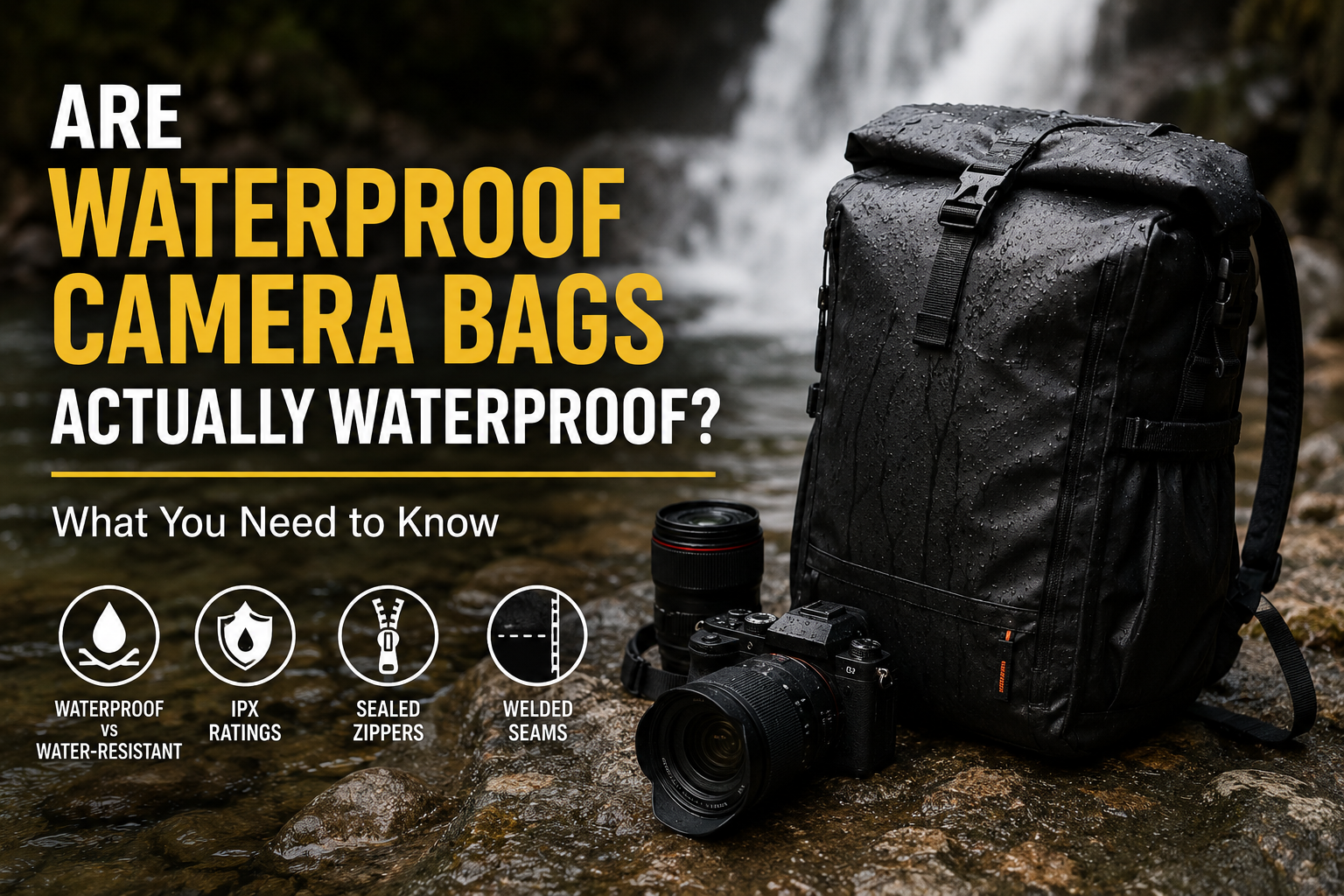
Most bags marketed as “waterproof camera bags” are actually only water-resistant, because true waterproofing requires a specific IPX rating, fully welded seams, and a sealed zipper system — features that only a small fraction of camera bags on the market actually have. In one of the more revealing tests of the category, a 2024 field test that fully submerged 12 popular “waterproof” camera backpacks in one meter of water for 30 minutes found that only 3 of them kept their contents completely dry. The other 9 all let water in somewhere — usually through the stitching, the zipper, or an unsealed pocket.
If you’ve ever trusted a bag’s “waterproof” label and ended up with damp gear anyway, you weren’t imagining it, and you weren’t doing anything wrong. The label itself is the problem — and this guide breaks down exactly what to check before you trust a bag with your camera near water.
Key Takeaways
- “Waterproof” is not a regulated term for consumer bags the way it is for electronics, so manufacturers can use it loosely without meeting any standardized test.
- A 2024 submersion test of 12 popular waterproof camera backpacks found only 3 stayed completely dry after 30 minutes at 1 meter depth — all three used welded seams and a roll-top closure.
- True waterproof bags rely on an IPX rating (IPX5 and above for waterproof claims, IPX7+ for submersion protection), not just a “waterproof” label on the tag.
- Independent testing consistently shows water enters through zippers and unsealed seams, not through the bag’s main fabric — a standard stitched zipper is almost always the weak point.
- A high denier fabric count (like 1000D nylon) indicates fabric toughness, not water protection — thickness and waterproofing are two separate specs entirely.
Is “Waterproof” on a Camera Bag Label Actually Regulated?
No — “waterproof” is not a regulated or certified term for consumer bags the way it is for electronics, which means a manufacturer can print “waterproof” on a tag without meeting any independent testing standard. Unlike phones and cameras, which follow standardized IPX ratings, most camera bags lack any required certification behind the word “waterproof,” so the term becomes a marketing choice rather than a guarantee.
This is why two bags can both say “waterproof” on the label while performing completely differently in the rain. One might use fully welded seams and a sealed zipper; the other might just have a water-resistant coating on the outer fabric and nothing protecting the seams or zipper at all. Without a listed IPX rating or hydrostatic head number, there’s no way to verify the claim — and industry guidance is consistent on this point: if a bag doesn’t list a rating, assume it’s only splash-resistant, not waterproof.
What’s the Real Difference Between Waterproof and Water-Resistant?
Water-resistant bags repel light moisture like drizzle and splashes, while truly waterproof bags are built with sealed construction that can handle sustained rain, jets of water, or full submersion without leaking. The distinction comes down to construction, not just the fabric’s coating:
- Water-resistant bags typically use a DWR (durable water repellent) coating on the outer fabric, which beads up light rain but eventually saturates in a downpour and does nothing to seal seams or zippers.
- Waterproof bags use welded seams (heat-fused rather than stitched, since stitching creates tiny needle holes that let water through), sealed or waterproof-rated zippers, and often a roll-top closure design borrowed from dry bags used in kayaking and rafting.
A simple rule of thumb from testers in the space: if the tag doesn’t list a technical rating — an IPX number or a millimeter water-column rating — treat the bag as water-resistant, not waterproof, regardless of what the marketing copy says.
What Do IPX Ratings Actually Mean for Camera Bags?
IPX ratings measure exactly how much water exposure a product can handle, on a scale where higher numbers mean more serious protection, and only IPX5 and above should really be labeled “waterproof” for practical purposes. Here’s what each level actually means for a camera bag:
- IPX1–IPX3 — protects against light dripping or splashes; fine for a drizzle, not a downpour
- IPX4 — protects against splashes from any direction; adequate for sudden showers during a commute
- IPX5–IPX6 — protects against low- and high-pressure water jets; suitable for heavy rain, hiking, and cycling
- IPX7 — protects against temporary submersion up to 1 meter for 30 minutes; the benchmark for bags that might end up in a river or get dropped near water
- IPX8 — protects against continuous submersion beyond 1 meter; the rating used for professional dry bags in kayaking, rafting, and diving
For most photographers shooting in rain or near water, IPX6 or IPX7 is the realistic target — IPX8 is typically overkill unless you’re doing serious watersports, and it usually adds weight, cost, and reduces the number of external pockets a bag can practically have.
Why Do “Waterproof” Camera Bags Still Leak?
Waterproof camera bags most commonly leak at the zipper and at stitched seams, not through the main body fabric, because these are the two places where the sealed barrier is hardest to maintain. Independent testing from photography publications has repeatedly found the same pattern: water ingress shows up at zippers and unsealed seams during sustained spray testing, almost never through the fabric itself.
A few specific failure points worth knowing about:
- Standard stitched zippers let water travel along the zipper tape through capillary action, even with a storm flap covering them — the flap helps but doesn’t eliminate the problem in sustained rain.
- Waterproof zippers (like YKK’s AquaGuard line) bond a TPU laminate over the zipper tape to genuinely block water, but they require careful alignment, regular lubrication, and can degrade after roughly 5,000 open-close cycles.
- Unsealed side pockets or laptop sleeves are a common weak spot even on bags with a fully sealed main compartment — manufacturers often seal the primary compartment but skip the smaller accessory pockets.
- Corner and strap attachment points are where thin waterproof fabric gets stressed under the weight of camera gear, which can quietly compromise the seal over time.
If you’re relying on a camera gear protection checklist before a shoot near water, checking the zipper type and seam construction matters more than trusting the word “waterproof” printed on the bag.
How Can You Test If Your Camera Bag Is Actually Waterproof?
You can test a camera bag’s real waterproofing at home using a simple dry-fill method: pack the bag with something absorbent like paper towels, close it exactly as you would when carrying gear, then expose it to water and check for moisture afterward. This costs nothing and takes about 30 minutes, and it’s a far more reliable indicator than trusting the label.
A simple two-step home test:
- Spray test — fill the bag with paper towels, close it fully, and spray it with a hose or shower head for two minutes, focusing on seams and zippers.
- Submersion or dunk test (for bags claiming submersion protection) — after the spray test passes, try briefly submerging the closed bag in a sink or tub and check the paper towels for any dampness.
If the paper towels are damp anywhere, note exactly where — that tells you the specific point of failure (usually a zipper or seam) rather than leaving you guessing. This same logic applies whether you’re testing a full camera backpack review candidate or checking an older bag you already own before a trip.
Which Features Actually Make a Camera Bag Waterproof?
The camera bags that hold up in real submersion and heavy rain testing consistently share four specific construction features, rather than relying on fabric alone. In the 2024 field test where only 3 of 12 bags stayed completely dry, all three successful bags shared the same construction approach: high-frequency (HF) welded seams, a roll-top closure, and TPU-coated fabric rated to a hydrostatic head of at least 10,000mm.
What to look for specifically:
- Welded (not stitched) seams — heat-fused seams eliminate the needle holes that stitching leaves behind, which are a direct path for water under pressure
- Roll-top closures — folding the top down multiple times before clipping it shut creates a genuinely sealed barrier, though it makes quick lens changes slower and less convenient
- TPU-coated fabric with a high hydrostatic head rating — a hydrostatic head of 10,000mm or higher indicates the fabric itself can resist real water pressure, not just light moisture
- Waterproof-rated zippers or no zippers on the main compartment at all — some of the most reliable waterproof designs skip a zippered main compartment entirely in favor of a hard-shell base or fully welded closure
The tradeoff is real: fully waterproof bags with these features tend to be heavier, more expensive, and less convenient for quick access than a standard camera backpack organization system built for everyday shooting. That’s a fair trade if you’re regularly near water — probably overkill if you’re mostly shooting indoors or in dry climates.
Frequently Asked Questions
Does a high denier (1000D) fabric rating mean a camera bag is waterproof?
No. Denier measures how thick and durable a fabric’s threads are, not whether it repels water. A thick, tough 1000D nylon fabric with no waterproof coating or membrane will still soak through in sustained rain — denier and waterproofing are two completely separate specifications that shouldn’t be confused.
What IP rating should I look for in a camera bag if I shoot near water regularly?
For regular exposure to heavy rain, splashes, or occasional dunking, look for at least IPX6, and consider IPX7 if there’s a real chance the bag could be briefly submerged (for example, kayaking or wading). IPX8 is generally unnecessary unless you’re doing sustained watersports or diving-adjacent shooting.
Can salt water affect a bag’s waterproof rating?
Yes, indirectly. Standard IPX testing is conducted in static fresh water at room temperature, so a rating doesn’t directly account for saltwater’s corrosive effects on metal zipper hardware or the way it can degrade gasket materials over time. If you shoot regularly near the ocean, expect more maintenance and a shorter effective lifespan on zippers and hardware than the IP rating alone would suggest.
Is a rain cover enough to protect my camera gear instead of buying a fully waterproof bag?
A rain cover paired with a water-resistant bag can handle light-to-moderate rain reasonably well, but it won’t protect against submersion, heavy spray from an angle, or prolonged downpours the way welded seams and sealed zippers can. If your main risk is walking through drizzle, a rain cover is often sufficient; if there’s real risk of the bag getting dunked or soaked for an extended period, it isn’t a substitute for genuine waterproof construction.
Final Thoughts: Trust the Rating, Not the Label
The word “waterproof” on a camera bag tells you almost nothing on its own — what actually matters is whether the bag has a real IPX rating, welded seams, and a sealed zipper or closure system built to back that claim up. Given that a controlled field test found the majority of “waterproof” camera backpacks still let water in somewhere, it’s worth spending five minutes checking the specific construction details — or running your own simple spray test — before trusting any bag with gear you can’t afford to replace.
If you’re shopping for a new bag, start by checking for a listed IPX rating and seam construction before anything else. If you already own one, run the paper-towel test this week so you know exactly what it can and can’t handle before you actually need it to perform.
Sources referenced: Pack Hacker 2024 field test (via Alibaba electronics buyer guide), VetoProPac (2026), Vancharli Outdoor / Alibaba Seller Blog (2026), Feesly Bag B2B Guide (2026), Eiken Shop (2026), Ruby+Rae materials science analysis (2026), Digital Filmmaker (2026), Itinerant Angler community forum, Shutterbug dry bag review roundup.
About the Author